Nobody's There
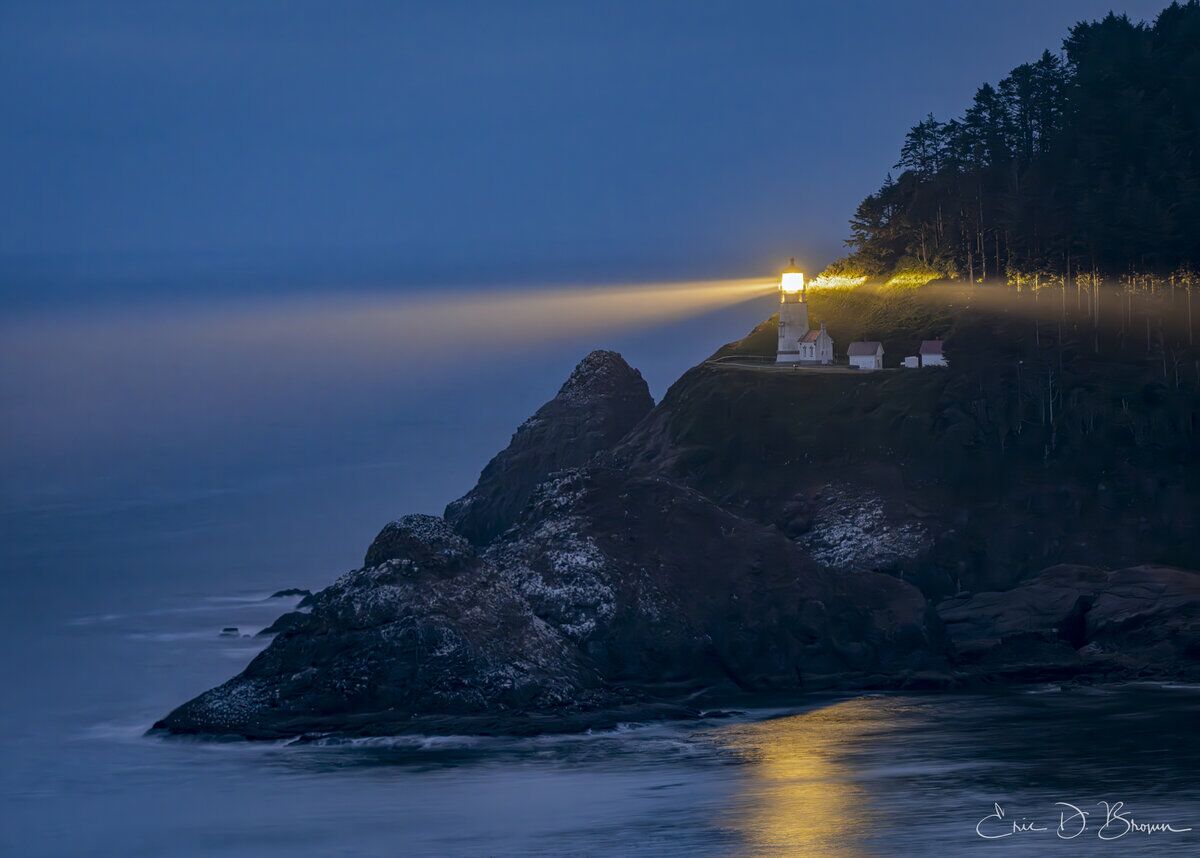
I took this photograph at Heceta Head Lighthouse on the Oregon coast, just after sunset, the beam cutting through fog as the daylight went. I waited about forty-five minutes in the cold to get it.
It’s a dramatic image. A lighthouse on a cliff, the beam slicing through the dark, the waves going off below. What you can’t see in it is people. Specifically, the people running the lighthouse, because there aren’t any.
Heceta Head was automated on July 20, 1963. The last keeper, a man named Oswald Allik, retired that same day. Now the light comes on by itself every night, the systems run their own checks, and the beam turns on schedule. Someone built all of that, and a technician shows up now and then to service the equipment, but most nights the lighthouse runs with nobody there. The work that keeps the light on is invisible.
I’ve been thinking about that because most of what I’ve done in my career doesn’t photograph well either. Data pipelines that run while everyone’s asleep. Systems built reliably enough that people forget they exist. Processes that keep working long after the team that built them has turned over. None of that makes a good post. Nobody celebrates the thing that quietly does its job for years without breaking. You only hear about it the day it fails.
The lighthouse doesn’t seem bothered by this. It doesn’t need someone standing watch to prove it matters, and it isn’t wondering whether some other lighthouse has better technology or gets more attention. It sits on that cliff because that’s where the rocks are and that’s where ships need the warning, not because the view is good or because anyone’s there to see it.
That’s the part that stays with me. The best work I’ve done is usually the work that ended up running without me. The system built well enough that it didn’t need me anymore. The decision that quietly prevented a problem nobody ever found out could happen. It doesn’t make for a good story at dinner, and it doesn’t match the picture we’re sold of what success is supposed to look like. It just keeps working.
There’s a quiet kind of pride in that, even though almost no one will ever see it. You build the thing right, and then you walk away, and it holds. The reliability becomes invisible precisely because it’s so consistent that nobody has to think about it.
Maybe that’s what the lighthouse has been trying to tell me. Nobody’s there, and the light still works.